Wet Processing – Processing of Mineral Material Mixtures Using Water
How wet processing separates mineral material mixtures, which processes and machines are used, and what matters in water management.
Wet Processing – Processing of Mineral Material Mixtures Using Water
In practice, mineral raw materials are rarely available as homogeneous materials. In most cases, they consist of complex mixtures of valuable and non-valuable components. Wet processing is a key method in mineral processing technology used to selectively separate these mixtures.
Water is used as a process medium to separate mineral particles based on physical properties such as density, particle size or wettability. In gravel, sand, ore and coal processing, wet processing has been a proven part of stable and efficient process chains for decades.
What Is Wet Processing?
Wet processing refers to the separation of mineral material mixtures using water as a transport and separation medium. The material is mixed with water and processed as a suspension through various processing stages.
In water, physical differences between particles are far more pronounced than in dry systems. This allows even fine or heavily contaminated materials to be separated reliably. Wet processing often forms the basis for downstream processing steps and product refinement.
How Does the Separation of Mineral Material Mixtures in Water Work?
Separation in water is based on the interaction of gravity, flow conditions and particle properties. Denser or coarser particles behave differently in water than lighter or finer components.
By precisely controlling flow velocities and water movement, particles can be suspended, stratified or selectively discharged. Water enables controlled process conditions and ensures reproducible separation results, even when material composition fluctuates.
Which Processes Are Used in Wet Processing?
Wet processing includes several technical processes that are combined depending on the raw material and processing objective.
- In gravity separation, particles are separated based on their density. Denser components settle more quickly, while lighter fractions are carried further by the flow.
- Hydraulic classification separates materials by particle size. Fine and coarse fractions are separated by defined flow conditions to stabilise downstream processes.
- Washing processes remove adhering fines, clays or organic components and improve product quality.
- For very fine particles, flotation is used. Differences in wettability are exploited to selectively separate valuable minerals.
Making Wet Processing More Efficient and Sustainable
Together, we analyse water circulation, process stability and savings potential in your processing plant.
Which Machines and Processes Are Used in Wet Processing?
Water-based processing plants use specialised equipment tailored to the respective separation principles.
Typical machines include jigging machines for gravity-based separation, classifiers and hydrocyclones for particle classification, as well as washing and screening equipment for material cleaning. These systems are complemented by flotation units and pump and piping systems for water handling.
Machine selection depends on raw material, feed size, throughput and desired product quality.
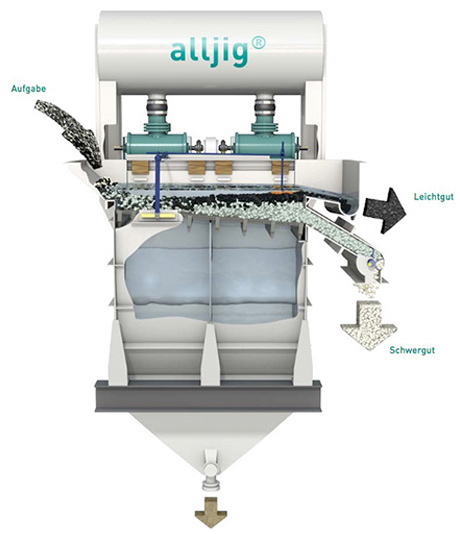
alljig® – Jigging Machine for Gravity-Based Separation
The alljig® jigging machine uses pulsating water flows to separate mineral material mixtures by density. It is suitable for coarse to medium particle sizes and is used in gravel, sand, ore and coal processing.
allgauss® – Wet Magnetic Separator
The allgauss® wet magnetic separator is used to separate paramagnetic minerals from water-based material streams. It increases selectivity in wet processes and optimally complements gravity and classification systems.
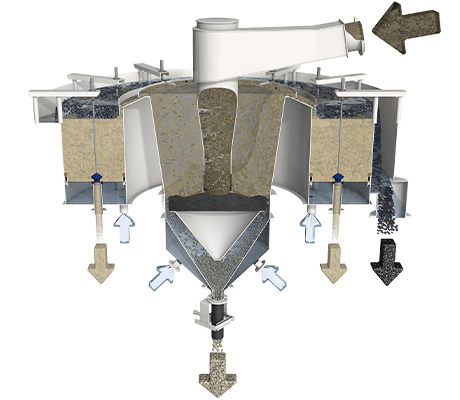
allflux® – Fluidised Bed Separator for Classification and Density Separation
allflux® combines hydraulic classification and density separation in a single process step. Especially for sand-water mixtures and fine materials, the technology ensures stable separation conditions and high process reliability.
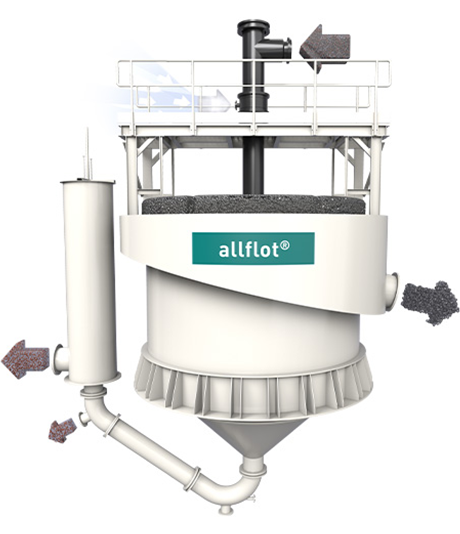
allflot® – Flotation System for Finest Particles
allflot® is used for very fine mineral particles where gravity-based processes reach their limits. Flotation enables the selective separation of valuable minerals from aqueous suspensions.
How Can Water-Based Processing Be Technically Optimised?
Technical optimisation of wet processing starts with coordinated process design. The goal is to configure water flows, residence times and separation stages in a way that minimises material losses and reduces energy consumption.
Modern plants rely on modular process chains, automated control systems and efficient water management. Precise coordination of individual machines improves separation efficiency and increases process stability, even with changing material properties.
How Can Wet Processing Be Made More Sustainable?
A key lever for sustainability is process water management. Modern wet processing plants operate with closed water circuits to significantly reduce fresh water consumption.
The process water is cleaned through sedimentation, classification or filtration and returned to the process. Sludges and fine fractions are selectively dewatered to minimise volume and disposal effort.
In addition, energy-efficient pump systems and optimised process control reduce energy consumption and operating costs.
Why Retrofit and Modernisation of Existing Wet Processing Plants Are Worthwhile
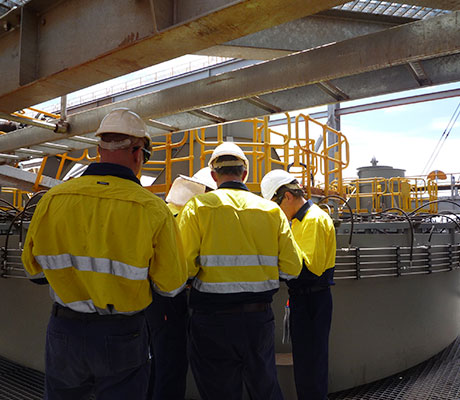
Retrofit and modernisation measures are particularly worthwhile when existing plants operate reliably but no longer meet current requirements for efficiency, water consumption or process stability.
By selectively replacing individual machines, optimising water circulation or integrating modern control technology, performance reserves can be unlocked without expanding the existing plant footprint.
This allows wet processing systems to be adapted economically and technically to new framework conditions.
Wet Processing Between Proven Technology and Modern Process Optimisation
Wet processing is a core method in mineral processing technology. It enables the efficient separation of complex material mixtures and remains indispensable in many applications.
Through modern processes, intelligent process water management and targeted modernisation, wet processing can now be made more efficient, sustainable and economical than ever before.
Do You Operate or Plan a Wet Processing Plant?
Let’s assess how separation performance, water consumption and operational reliability can be optimised.
Wet processing refers to the separation of mineral material mixtures using water as a process and separation medium.
Wet processing is used for gravel, sand, ores, coal and other mineral raw materials.
Water enables targeted separation by density and particle size and improves separation efficiency, especially for fine materials.
By using closed water circuits, sedimentation and filtration, process water can be reused multiple times.
- Product Overview → Our Products
- Spare Parts Service → Maintenance & Repairs
- Service Profile → Services
- O&M Services → Operational Support
- Contact → Contact Page
| Send email now to: | head(at)allmineral.com |
| Call now: | +49 (0) 211 522 88 0 |